It is now common practice for members of the African diaspora to send money back home. With mobile money technology, the process has never been faster and cheaper. In a matter of seconds, I can send money from the US to anyone in Rwanda, they would receive it in their mobile money account and they wouldn’t need to go to a bank or another financial institution for withdrawal.
Thus, it is not surprising that last year, remittances to Africa reached $200 Billion, surpassing the Official Development Assistance (ODA) and Foreign Direct Investments (FDI). The World Bank and the UN have hailed remittances as an alternative source of development finance for the continent, and rightly so.
However, the downside that is not discussed often is the opportunity cost of remittances–labor supply loss. This is particularly significant in Africa where migrants are more educated due to the arduous process of obtaining migration documents. This special feature of the migration and remittances dynamic in Africa adds an element of urgency to make remittances work for Africa.
It is prime time for remittances to be scaled up into high-impact investments. This necessitates moving from individual or family remittances and tapping into more collective, development-focused remittances. For instance, diaspora bonds have not yet taken hold on the continent. This is one avenue that governments need to explore to better pool resources from the diaspora and allocate them to long-term development projects.
Remittances are increasing; we need to make sure that this trend yields positive results.
In a historic turn of events, the Los Angeles Lakers emerged victorious in the inaugural NBA in-season tournament, leaving fans and pundits alike in awe of their resilience and dominance on the court. The tournament, introduced to inject excitement into the regular season, provided a platform for teams to showcase their prowess in a condensed, high-stakes format. The Lakers, led by their star-studded roster and the indomitable LeBron James, etched their names into the annals of basketball history with a triumphant run that captivated the entire league.
The road to victory was anything but easy for the Lakers. The tournament featured a rigorous schedule, with teams battling it out in a series of intense matchups, each carrying the weight of heightened stakes and a coveted trophy. From the opening tip-off, the Lakers displayed an unyielding determination to seize the moment, blending the experience of seasoned veterans with the exuberance of young talents.
LeBron James, the perennial maestro, showcased his leadership and unmatched skill set, delivering one stellar performance after another. His ability to elevate the play of his teammates and execute clutch plays when it mattered most proved to be the cornerstone of the Lakers’ success. The in-season tournament became a stage for LeBron to further solidify his legacy as one of the greatest players in NBA history.
While LeBron’s brilliance was undoubtedly a driving force, the Lakers’ triumph was a collective effort. Anthony Davis, the Lakers’ towering presence in the paint, anchored the defense with his shot-blocking prowess and secured crucial rebounds. The supporting cast, including the likes of Russell Westbrook, played pivotal roles, contributing both offensively and defensively to secure hard-fought victories.
The tournament’s format, featuring single-elimination rounds, added a sense of urgency and drama to each game. The Lakers found themselves in nail-biting contests that tested their mettle and showcased their ability to thrive under pressure. The intensity of the tournament brought out the best in the team, fostering a camaraderie that went beyond the confines of a typical regular-season matchup.
As the Lakers progressed through the tournament, the anticipation among fans reached a fever pitch. The team’s journey resonated with supporters who reveled in the opportunity to witness their favorite franchise pursue glory in a novel and exhilarating competition. The city of Los Angeles, known for its storied basketball culture, erupted in celebration as the Lakers advanced through the rounds, with fans donning purple and gold in a vibrant display of support.
The championship game, a culmination of weeks of grueling competition, saw the Lakers facing a formidable opponent. Yet, true to their championship pedigree, the Lakers rose to the occasion, executing their game plan with precision and flair. The final buzzer marked not only the end of a thrilling tournament but also the beginning of a new tradition in the NBA.
The Lakers’ victory in the in-season tournament not only added another trophy to their illustrious franchise history but also served as a testament to their adaptability and championship mentality. As the league reflects on this groundbreaking tournament, the Lakers stand as the standard-bearers, showcasing the resilience and excellence that define the essence of basketball at its highest level.
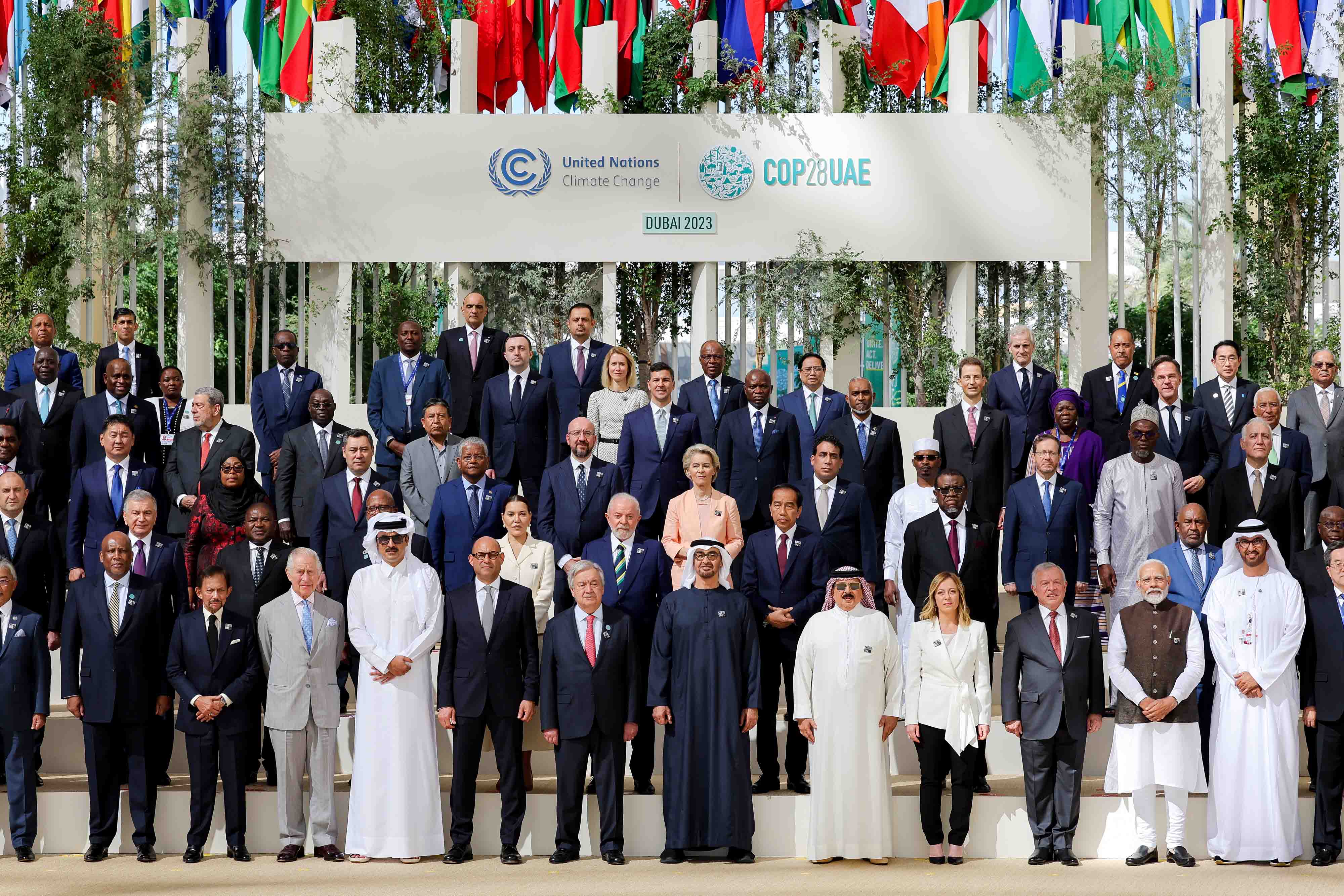
DECEMBER 1: World Heads of State pose for a group photo at Al Wasl during the UN Climate Change Conference COP28 at Expo City Dubai on December 1, 2023, in Dubai, United Arab Emirates. (Photo by COP28 / Mahmoud Khaled)
As the world grapples with the escalating challenges of climate change, the urgency to find effective and equitable solutions has never been more pronounced. COP28, the 28th Conference of the Parties, stands as a pivotal moment in the global fight against climate change. Key among priorities at the summit is to increase financing for developing countries to support their climate change adaptation capacities–thus, the Loss and Damage Fund.
Mobilizing financial resources for climate action remains a critical aspect of global efforts. COP28 must address the financing gap and encourage increased investment in sustainable practices. This includes both public and private sectors contributing to projects that promote renewable energy, sustainable agriculture, and eco-friendly infrastructure.
The Loss and Damage Fund acknowledges that certain regions, particularly those least responsible for greenhouse gas emissions, face severe consequences such as rising sea levels, extreme weather events, and loss of biodiversity. COP28 recognizes the moral imperative to assist these communities in coping with and recovering from the irreparable harm inflicted by climate change.
This fund was championed by the host country UAE, which pledged $100 million to the fund. The European Union, US, UK, China, and other nations quickly followed suit, leading to a total of $700 million in pledges in just about 2 days.
Furthermore, COP28 will delve into the operational aspects of the Loss and Damage Fund, discussing transparent mechanisms for allocating resources and ensuring that funds reach the communities in greatest need. The discussions will also revolve around innovative approaches, including risk reduction strategies, insurance mechanisms, and capacity-building initiatives to empower vulnerable regions to better respond to and recover from climate-induced losses.
By addressing the Loss and Damage Fund at COP28, the international community sends a powerful message about shared responsibility and solidarity in the face of climate crisis. It is a testament to the acknowledgment that, despite concerted efforts, some losses are inevitable, and concerted global action is necessary to mitigate the impact on those who have contributed least to the climate crisis.
It is a chilly December 2022 night and I am in an Irish bar in Rome on Via del Plebiscito, right in the center of the city. That night, the crowd is more excited than usual and quite distinguishable. One group in particular, more than the rest. More than half of the people in the bar are either wearing blue jersey shirts with white and red stripes, or they have painted those colors on their faces. They feel it is going to be a historic night. The defending champions, France, are facing off against the tournament’s black horse, Morocco, to secure a consecutive spot in the FIFA World Cup final.
I, too, can smell history up close–but for a different reason. For the first time ever, a team from Africa can make it to the final. As I enter the bar, knowing that my friends are still on their way, I look for an opposite corner from the fans in blue, where I hope to create a crowd of Morocco’s supporters. But of course, we are in Italy and they cannot be as many as France’s. Still, I am hopeful and I can already imagine a tiny group of a dozen people taking over the massive bar at the full-time whistle. I order a drink, my friends arrive, the game starts.
Five minutes into the match, the noise in the bar is deafening. France has scored. But I remain undeterred. After all, the Atlas Lions have overcome worse odds in the tournament already. Under the euphoria of expectations, I applaud, scream, and whistle at every Morocco’s offensive action in the game. At half-time we are still one goal down, so we can still come back. Yes, we. I was Moroccan that night–for the first time in my life. My Larynx needs rest though. I order another pint of Guiness.
The second half starts. Morocco’s big names are visibly trying. Amrabat is bossing the midfield, while Hakimi and Mazroui are attacking the flanks. But the threat of Mbappe and France persists. Morocco gets its moments but France is pretty much in control. At the 79th minute, they score their second goal. The game is slipping out of Morocco’s hands. By this time, celebrations in the other corner have started. Victory tonight is theirs; they know it, I know it. The game ends, the bar’s DJ blasts Vagedream’s hit on. It’s time to go home. I bid my friends good night and I leave. But surprisingly, I am not disappointed in the loss. Instead, I am suddenly conflicted with other emotions. I am happy for a memorable footbal moment; I am proud of Morocco’s fight throughout the tournament; I am envious of French fans; I am very reflective on what football means to so many of us across the world–all at the same time.